

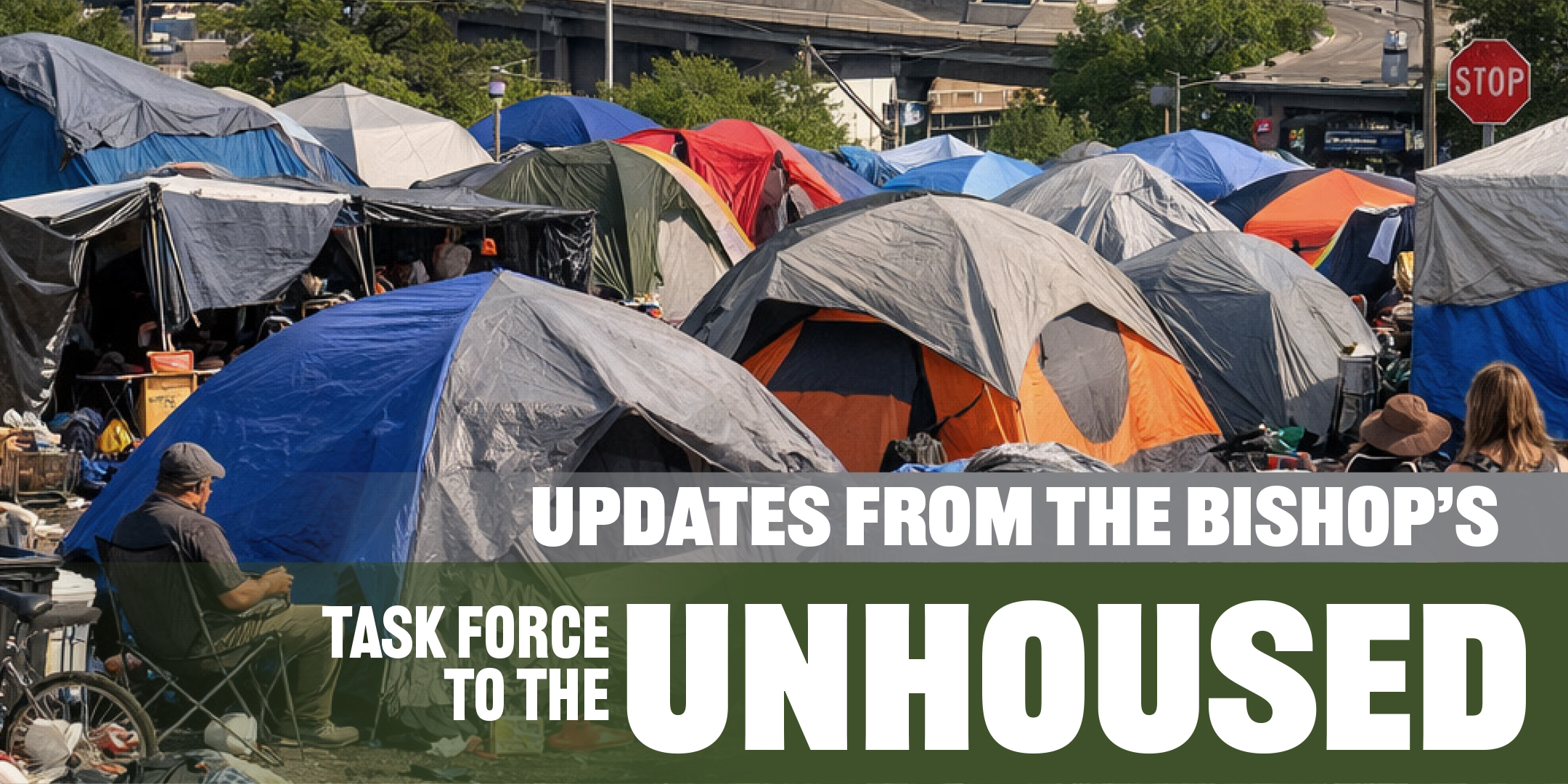
From Don Fornoff, co-chair of the Bishop’s Task Force to the Unhoused:
Some days it’s hard to grasp situations about the unhoused. How can so many people become homeless? How come it costs so much to take care of the programs which we think will solve the homelessness crisis? With a lot of reading over a long period of time, although numbers may change, common situations reveal themselves.
- 6 in 10 of all people live paycheck to paycheck. That’s everybody, nationwide.
- For those people, cash reserves are alarmingly low, mostly below what it would take to pay for a car repair or a minor medical bill.
- 1 in every 4 may have slipped over the edge into becoming homeless. Not that they became unhoused. They are teetering on the edge. Many of these are families!
- 3 in 10 homeless situations are caused by rent increases. Cost of housing increases, local living conditions, landlords with other concerns, property managers, renter situations, physical conditions, attorneys for both sides – circumstances can push all involved to make it hard to resolve the issues. It is the renters who are pushed to the brink.
- 1 in 10 have unexpected health issues, often-times complex, whether insured, uninsured or underinsured. A more recent situation has been cited by a Reuters journalist that 1/3 of all Americans (82 million people) are having to make decisions about what to give up because of rising healthcare bills, rising premiums, or just going for treatment in the first place. And that’s mostly because of one budgetary policy passed by Congress that just went into effect in January of this year.
- 1or 2 in 10 have job loss.
- Domestic abuse, child abuse and drug abuse may be a part of a few situations.
All these situations are contributing factors, but it is the economic reasons that give rise to homelessness. I believe it means that all causal reasons must be addressed case by case for each unhoused individual or family. Because everyone is our neighbor, as I see it. Rabbi Joachim Prinz said: “Neighbor is not a geographic term; it is a moral concept.” We need to take care to pay attention to and be prepared to provide support to get people into stable situations. That support is called ‘continuum of care’. That means the wide range of support systems, affordability and social services tied to individual needs. I contend it’s a long-term contract between the community and the community’s residents. It’s a contract most jurisdictions have a hard time keeping up with.
Let’s look at these issues in a few other ways:
- Chronic cases deserve a look. It has been cited that 6 in 10 people who have moved off the streets have been homeless for over 1 or 2 years, longevity that for too long constitutes a community failure itself.
- Seemingly innocuous comments can cause negative responses to this nationwide blight. Ronald Reagan said in the 1980’s homeless people just wanted to live outside. How much trouble and negativity has this unthoughtful comment caused over the years? And many more like it.
- Another long-term effect comes from racist policies. Despite being under 10% of the total population, 5 in 10 unhoused are people of color or indigenous.
A positive note can be found in Seattle, from volunteer supported Sound Foundations, builder of tiny houses for tiny house villages, comes some facts from a recent release. Low Income Housing Institute (LIHI) tiny homes villages had a 90% occupancy rate, meaning tiny homes are desirable. 98% of those who moved into permanent housing are still housed, meaning tiny homes are effective at breaking the cycle of homelessness. The cost is $4500 per home (roughly $25-28K when a full infrastructure is factored in). That’s a one-time cost, lasting for 20 years or more. Each home houses multiple people, perhaps 2 per year. By comparison, apartments cost $300-325K to build and converted hotel rooms are $285K when rapid supportive housing is needed. This cost disparity must be considered!
From a University of Washington alumni magazine comes an article about Ken Lombard of BRIDGE Housing Corp. who debunked a few myths about the unhoused. The myth – all unhoused people prefer to live outside. Lombard says media outlets can find 1 or 2 people who like living in a tent. The truth – if offered, most readily move inside. The myth – homelessness is a byproduct of addiction. The truth – based on exhaustive studies of homelessness in relationship to many cultural and physical causes, it all comes down to the cost and stability of housing. Professor Greg Colburn of Seattle was quoted from his study. The myth – affordable housing hurts property values. The truth is, thanks to good design, property values have increased in neighborhoods with new affordable housing.
For interested parishes, contact the co-chair of the Bishop’s Task Force to the Unhoused in order to schedule a more in-depth presentation to your congregants and outreach people, to further ponder and question the meaning of the homeless situation in your area. You can reach us at taskforce2unhoused@ecww.org.