Image by https://www.cop27.eg/assets/img/cop27-logo.svg, Fair use, https://en.wikipedia.org/w/index.php?curid=72213177

Our very own Missioner for Climate Care and Climate Justice, John Kydd, is part of The Episcopal Church’s delegation to the 2022 United Nations Climate Change Conference (more commonly known as COP27) in Sharm El Sheikh, Egypt this year. You can find John’s reflections, prayers, and updates at the links below.

Image by https://www.cop27.eg/assets/img/cop27-logo.svg, Fair use, https://en.wikipedia.org/w/index.php?curid=72213177

From John Kydd, Missioner for Climate Care and Climate Justice:

It’s about 6 am in Sharm el Sheikh, and the call to prayer (adhan meaning “to listen”) rolls gently past my patio and out toward the Red Sea. The singer (muezzin) has a wonderful voice, deep and marbled with feeling. A second, a female-sounding voice, steps in. No duet, just the adhan through a different register.

The first call is to come to prayer (Hayya alas salah). The singer lingers lovingly on the H, the al, and the lah. The second call is to come to safety/salvation (Hayya alas salah) followed by a studied silence where the phrase lingers in its absence.

Adhan occurs five times a day, beginning at the first hint of sunset (Mahgrib), then at sundown (Isha), then at the first hint of sunrise (Fajr), then just after the sun passes its zenith (Zuhr), and then halfway to the sunset (Asr). Here Mother Nature rings the bells for when to gather to pray.

Similarly at COP 27, we are first called to listen to all the registers of humanity and the rest of creation, then to seek to discover a sustainable safety (salvation) for a changing Creation. The COP endeavor, staggeringly complex and immense, is chock full of calls to listen and act.

And listen we do, searching for a way forward as time grows short. While the geoscience of what we must do is clear, the political science of how to get there is not. As Moses found while wandering not far from here, the path to the promised land is long.

The desert wind swirls with many truths. First is that the COP is far from where it needs to be. A second truth lies in the thousands of utterly devoted people who’ve been at COPS for decades, riding the late-night buses home after exhaustive negotiations. These “can do” people, like Moses, are determined to leave Fossil Fuel Pharoah in the dust. A third truth is held by the golden calf crew of 638 known fossil fuel representatives. While touting devotion to climate, they skillfully defer progress by disputing the workability of solutions, often declaring that the market will discover what we need to do. They push back, divert, and distract from what is called for. Much of the psychology behind their tactics was developed in the U.S. to delay regulation of DDT, tobacco, and other inherently harmful products.

Both determination and despair lurk in the air. A COP presentation by a director of the Club of Rome showed a UNICEF documentary on the massive loss of lives and livelihoods this year. A few minutes into the discussion, this seasoned director began to cry in the center of the stage. The audience fell silent. Then some applauded, and many joined her tears. She said:

I’ve been going to COP for ten years, and I have to say we are getting nowhere. Doing this is just enabling evasion of fundamental responsibility. If they let 1.5°C go, I am not coming back.

Many stood and applauded. The mic went to an older man who said:

We are in the middle of an ecocide where the agents of ecocide refuse to define it or outlaw it; I don’t know how to explain this to my daughter…

He choked up, covered his face, and sobbed.

The “if they let 1.5°C go” is more than a possibility. Per the UNFCC, implementing the current country pledges would put us at a 2.5°C warmer world by 2100. The updated science report found that passing 1.5°C will make changes we cannot adapt to. At the present pace, we will get to 1.5°C by 2030. Yikes.

Leaving the auditorium, I saw a flickering noticeboard far down the corridor. The lecture title was “Magical Realism and Climate.” It wasn’t on the UNFCC program. I went in. The stage was spare and dark with a spotlight framing a sturdily-carved wooden stool. There were no video techs, no mic-tests for sound. Folks filed in.

The silence was oddly refreshing as the digital clock ticked down. Then a speaker shuffled in slowly from stage right. A massive beard framed his sad face as he turned to sit on the stool. Mild curiosity turned into recognition that tore faces from cellphones: it was Santa Claus without his hat. Smoothing his hair back, he spoke:

I planned to begin with a hearty laugh and good wishes to all, but I barely made it here on time. November is peak production, and I’ve had to put in ten sump pumps this week to keep the elves’ workshop from flooding. We’ve never faced heat like this. The dampness makes the ribbons droop, and half of my elves are in therapy for adjustment disorders…

He stopped, stared at the floor, and then gazed slowly across every face in the audience. He began again with a tight smile.

I’m sorry. This shouldn’t be about me. It’s about you and us. I had the privilege of knowing each of you years ago, feeling your hopes and joys and sorrows. I can’t describe the beauty and power of what you felt and what a few of you still feel. Together you could move mountains, and this “together” thing is what I want to talk about.

Together we’ve lit the world anew every year for centuries. But there’s this other “together” that you can’t seem to stop that will soon melt me out of my home and job. You’ve been trying to undo this other “together” for 35 years now. Some of you have done fabulous work, and I’m proud of you.

I’m here because time is dear. I don’t know how to describe the feeling of millions of children losing their homes to flood or famine or drought. It’s a horrible symphony of souls shrinking and hopes collapsing. My heart shudders watching the lovely light drain from their eyes.

This is only part of it. I don’t just deliver to human kids. I deliver to all the people’s kids: all the four-legged and two-legged and finned and feathered and rooted and leaved and the waters and lands and winds because they all talk to me. Maybe they still talk to a few of you. I’m also there for your ancestors and theirs because they are sick with worry right now. Creator cries every time the last of a species dies.

Santa paused, looked down at the stage, and folded his arms. The silence sank into sadness as he gathered his thoughts. His gaze rose slowly to meet our eyes.

I’m not just about the children. I feel how badly and sadly you feel, how hard you’re trying to stop all the dying. I feel the screams in your dreams and how lonely it seems. I’m right there with all your despair and with your coping and your hoping.

But I’m here to thank your harried hearts for what you do. Though I forgot my hat, I take it off to you.

It’s time to explore what more we can do. Let’s begin with love of what we know is true, a love that lives in the me of you. This is more than reindeer and more than elves; this is finding our long-lost selves.

Climate is not a problem to solve. It is a relation to repair.

Tapping his forehead, he said:

You can’t solve it here.

Moving his hand to his heart:

Until you can hold it all here.

Your hearts can become stronger than strong, but only if you feel together, only if you belong.

Santa may be a fiction in your head, but you and I were “we” in your childhood heart. It’s there that we will start.

It’s there that everything Creator made matters. Each should be honored on your tree. Ornaments for wind and rain, for mountain, cloud, and sea; for all that swim and all that fly; for all that crawl, all that root, all that lie, and all that invisibly multiply.

For humans we need more. Ornaments celebrating every race, every sex, and every form of “them.” Ornaments to the hidden histories of hunger, fear, and horrific harm that we must face; an ornament for those silly rich men who seek refuge in space.

Your holiday tree holds your family, its privileges and its shames. Only if we heal us can we stop the rivers of blame.

Every buried trauma should be an ornament upon your tree because when you heal more of you, you heal more of we.

Then there’s the tree stump: all the roots that we cut off in order to fit in.
Root into your ancestors and branch into your kin.
Only by meeting all of you will the truth of you come in.
This will be difficult, not easy, and very far from fast,
But only if you find yourself can you find a solution that will last.

Santa stopped, opened his arms wide, gazed again from face to face and said:

I’ve said a lot here because each of your hearts met mine when you were young and left when you became smart. To fix this climate thing, please return to that believing place. It’s time for olders like you and me to become elders who retire into serving this mystery.

He then turned in a slow circle, his polished boots flashing in the spotlight, and looked back at us with a twinkle in his eye:

Thank you for the work you will do. I’m sorry I have to go. If you want to boil this down to basics—
My “HO HO HO!” has become “HO HO KNOW!”

With that, he walked away.

COP has magical moments. Not pretend magic like insisting that markets have the answers and that economies matter more than hearts. Love magic.

Love’s the axis around which our holidays spin. Can we share Santa’s big love, making acting on climate change as common and comfortable as sharing a cup of coffee? Big love is patient and kind and never quits. There’s no heart that it can’t fit.

Big Love Holidays to you.

John Kydd

Image by https://www.cop27.eg/assets/img/cop27-logo.svg, Fair use, https://en.wikipedia.org/w/index.php?curid=72213177

Doing work within the UN network is inspiring and daunting. Inspiring to see so many people work so hard to forge astonishing compromises like the Paris Accords and daunting to fathom the terminology, the alphabet soup of acronyms, and the failures to face fundamental issues.

To say anything definitive about the UN process normally requires a few dozen numerical references. Here we will be practical and informal.

The UNFCC

This is the UN Framework Convention on Climate Change. It came into force on March 21, 1994. It was one of two conventions opened for signature at the 1992 Rio Earth Summit. All 198 countries (and entities like the Papal See) of the UN ratified it. This was remarkable. It set lofty goals to stabilize greenhouse gas concentrations “at a level that would prevent dangerous anthropogenic interference with the climate system”. They sought to nip this problem in the bud agreeing that:

“such a level should be achieved within a time frame sufficient to allow ecosystems to adapt naturally to climate change, to ensure that food production is not threatened and enable economic development to proceed in a sustainable manner.”

The onus to reduce emissions was put primarily on developed countries with a long history of emissions. These were the 38 members of the OECD (Organization for Economic Cooperation and Development). https://www.oecd.org/about/document/ratification-oecd-convention.htm. In UNFCCC speak these are referred to as “Annex I” countries. Annex I countries agreed to assist developing countries on climate-related issues.

The Convention

The UN itself is a Convention. It was based upon the League of Nations that was drafted at the end of WW I. It was the first IGO (Intergovernmental Organization). While most prominent nations joined the League, the US did not (this will be an evolving theme to discuss later).

While the League was created after hostilities were mostly ended in WW I, the UN was created while hostilities were still active after the League failed to prevent WW II. In a real sense, the UN is the League of Nations 2.0, remedying many (but not all) shortcomings of the League. A key change was in the rule of unanimity. In the League, all members had to agree for any substantive resolution to pass. Every member had a veto. The UN Charter reduced the veto to the then five major powers (China, France, Russian Federation, and the United States). The US committed to funding about 50% of the costs and to building the primary for the UN in New York City. The UN was founded on October 24, 1945.

The Confusions of Convention

The common meaning of “convention” is a meeting, often of experts or those sharing a similar interest. Conventions also refer to unwritten rules; how things are done “conventionally” or to reason itself, “conventional wisdom”. Conventions in this sense are not binding.

The UNFCCC (like the UN) is an “international convention”. As such it has come to mean a broad international agreement hopefully enforceable under international law on present and future concerns in a defined area. Legally it is enforced like a “treaty”, but “treaties” normally concern specific states on specific issues, so they are a law that binds only the parties to the treaty. Sadly, there is considerable overlap between “convention” “covenant” “protocol”, “treaty”, “charter” “agreement” and “pact”. All are considered forms of treaties. Language sometimes trumps this. The Paris Accord is actually an “agreement” but in French, it is “accord de Paris”.

Please note that one incentive for hosting a global meeting is the possibility of naming a successful agreement after the host city. This is smart marketing.

Within the UNFCCC terms are less murky. A protocol (like the Montreal Protocol) is a signed specific commitment that will hopefully become part of the larger convention if everyone buys in. The Kyoto Protocol failed, in part, because the US and China did not sign up. The Montreal Protocol (to phase out ozone depleting substances (ODS)), succeeded because there was more buy-in and less cost to implement.

The Framework Convention and a Major Shortcoming of UNFCCC

Conventions that address narrow definable issues such as the Convention against Torture or the Convention against Genocide are less complex and more direct in enforcement. Framework conventions are used for more complex phenomena where the thing to be avoided, the process by which it can be avoided, and the duties of participating states are less clear.
A framework convention is a multi-track process that seeks to define the problem, evaluate the feasibility of remedies, seek consensus on how to implement them, and build voluntary country commitment to do so. Because of this, “Framework Conventions” allow more participation by non-state parties. This is good for folks like us but bad if hundreds of fossil fuel folks are allowed in.

The UNFCCC must also evolve a flexible administrative apparatus to oversee implementation of the final form of the Convention. This favors a process that is very deferential to the parties in order to convince all parties to voluntarily commit. In climate negotiations it is particularly important to get all the parties on board because the Convention is costly to their economies and those who evade commitment can secure significant unfair economical advantage and those who commit could find themselves losing political support at home. This is a tight rope process where high level diplomatic skills are critical.

Comparing UNFCCC to the US Constitutional Convention

The process we undertook beginning in May of 1787 involved only fifty-five delegates and it was convened in private. The UNFCCC has 198 voting members, thousands of Stakeholders and is mostly public and thus subject to intense partisan lobbying. While our US Constitutional convention was quite remarkable, the UNFCCC process is more complex by several orders of magnitude. It is like comparing checkers to three-dimensional chess.

This is why criticism of COP representatives as “failing” is dangerous. Firstly, it is semi miraculous that this amount of progress has been made. Secondly, vested interests that silently oppose UNFCCC want folks to think that we are simply humanly unable to pull this off. A significant part of the corporate community sees climate change as something they can profit from. These organizations face the world as being devoutly “green” while positioning themselves to profit from the staggering reconstruction costs resulting from climate change. Tech companies also profit from our failure as it drives up the willingness to invest in carbon capture, desalination, and atmospheric geoengineering (another fun topic!).

A Structural Shortcoming of UNFCCC: The Vampire Problem

As noted by Bishop Marc, we are given “observer” status. So too are many more fossil fuel (‘Industry” or “Commerce” representatives). At Glasgow there were at least 503 fossil fuel reps lobbying behind faux organizations like the Global Climate Coalition. There were more fossil fuel reps than any single country and they have more capacity to make capital commitments. If you wish to nerd into this, here is nice article that captures some of the Faustian folks who are furtive fixtures at COP. https://climateinvestigations.org/thousands-of-fossil-fuel-observers-attended-climate-negotiations-unfccc-data-2005-2018-cop1-cop24/

At Sharm el Sheik there are over 636 mostly furtive fossil fuel reps. This was compiled by Global Witness and Corporate Accountability. They are skillful and sophisticated, frequently fronting for green organizations. Since they have money to devote to green causes, they have clout. They are given more clout by the fact that Developed Countries are not stepping up to make the promised payments for mitigation, adaptation and loss and damage. As the climate tragedies grow ever worse, desperation rises.

Vampires are strangely like some of the colonists of centuries past who promised to bring civilization, reason, God and all other good things. Today the promise is for “development” “investment”, “prosperity”. The promotion is pseudo evangelical with touting of “lifesaving technologies.”

While some are indeed valuable, many do little to stop carbon expression. Instead, they collectively and skillfully imply that we can invent our way out of the problem. Hope in the “future” of “technology” or “innovation” is one of the more artful ways to avoid making the difficult decisions we must make now about paying for the work that must be done.

The UNFCCC could have kept the fossil fuel agents at arm’s length. It did not have to be this way. In the WHO Framework Convention for the Control of Tobacco (FCTC) the tobacco folks were excluded, and their influence was policed. The language they used then could easily be applied to fossil fuel folks now.

World Health Assembly resolution WHA54.18 noted:

“the tobacco industry has operated for years with the express intention of subverting the role of governments and of WHO in implementing public health policies to combat the tobacco epidemic.”

The Preamble noted that:

“need to be alert to any efforts by the tobacco industry to undermine or subvert tobacco control efforts and the need to be informed of activities of the tobacco industry that have a negative impact on tobacco control efforts”.

Article 5.3 of the Convention requires that:

“in setting and implementing their public health policies with respect to tobacco control, Parties shall act to protect these policies from commercial and other vested interests of the tobacco industry in accordance with national law”.

UNFCCC can find a way back by adopting “transparency” requirements forcing “observers” to declare any conflict of interest. A 2017 Guardian article summarizes some of these efforts. https://www.theguardian.com/environment/2017/may/17/fossil-fuel-lobby-to-declare-interests-at-un-talks. Our group may wish to explore support of this endeavor.

There will be many such lobbyists at COP 27, but this time they will be supported by the African Union due in part to Annex II1, countries failure to deliver promised funds, are now turning back to fossil fuel and nuclear for needed development. https://www.reuters.com/world/africa/african-countries-push-common-energy-position-cop27-2022-10-04/

The UNFCCC COP (Conference of the Parties)

The COP is the decision-making body of the UNFCCC that meets annually. Many years were spent trying to agree to a process by which State Parties could commit to goals. At the Warsaw COP of 2013, they passed a mechanism for nations to commit called Intended Nationally Determined Contributions, now called NDC’s (or more formally, INDC’s). A key part of the COP process is getting State parties to “up” their NDC’s.

The failure to commit to sufficient NDC’s is sometimes called the “Gap in Ambition” and the realization of “ambition” is largely through increased NDC commitment.

The Intergovernmental Panel on Climate Change (IPCC)

The IPCC is the most impressive global scientific collaboration in human history. The Fifth Assessment Report was over 3,000 pages (14,000 peer-reviewed articles) and composed of about 2000 scientists nominated by other scientists. Thankfully, the fossil fuel lobby has not penetrated the IPCC directly. Please spend some time touring their website at https://www.ipcc.ch/. The graphics are great and can be copied for your use.

The easiest overview report is the Synthesis Report which has a 5-10 page Summary for Policymakers and a 30-40 page non-technical summary. The Sixth Assessment is due in late 2022 or early 2023. The Fifth (AR5 Synthesis Report) can be found here. https://www.ipcc.ch/report/ar5/syr/. Please consider reading it so you can understand more of the scientific framework and conclusions.

The 6th Assessment report is broken into six domains:

One of the most fascinating aspects of the IPCC is the long-term projections. If you want to nerd out on them. check this out. https://www.ipcc.ch/site/assets/uploads/2018/02/WG1AR5_Chapter12_FINAL.pdf.

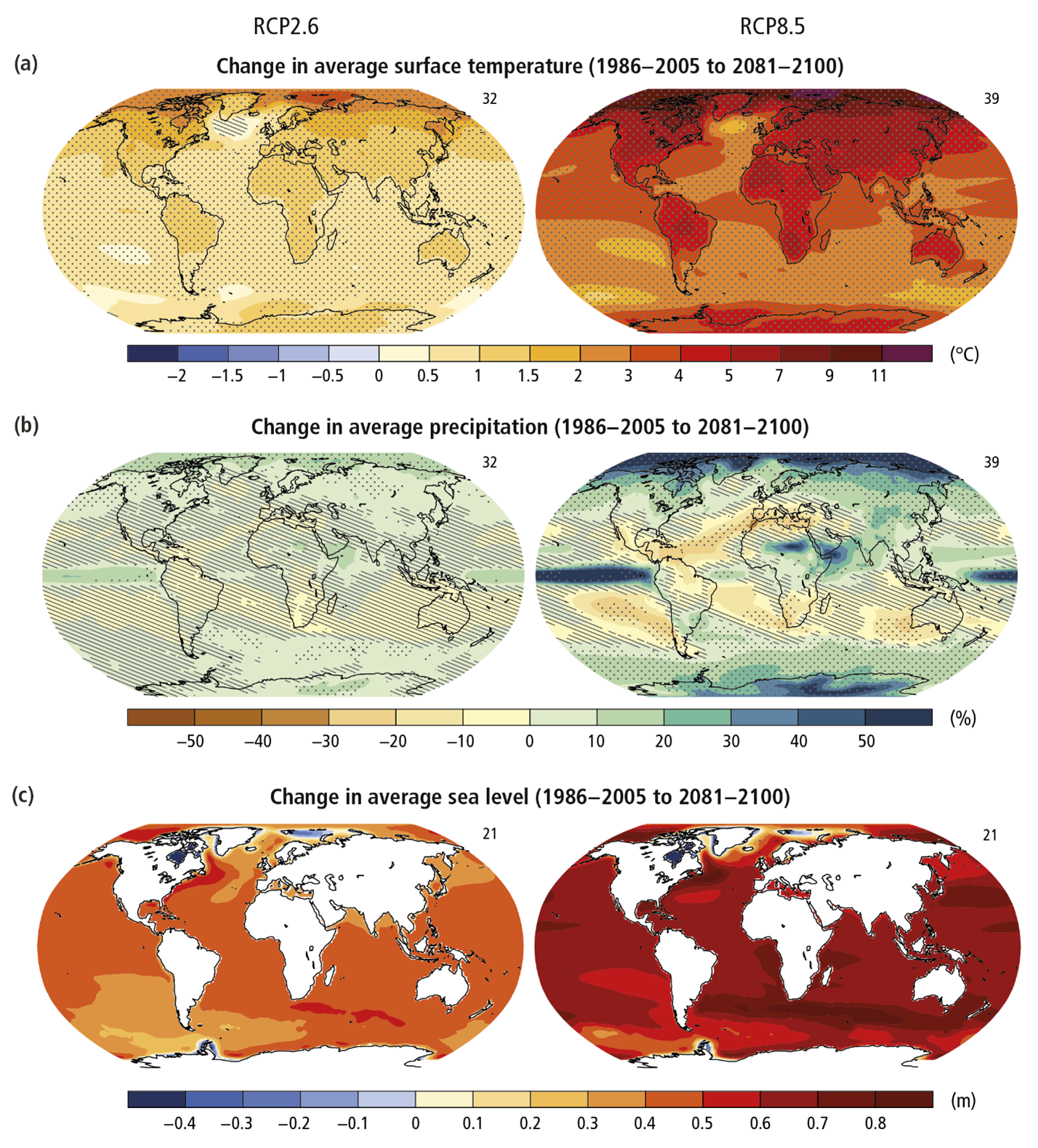
The projections begin with geophysical change by region and other variables and then project five Shared Socioeconomic Pathways (SSP’s). In this manner they brilliantly project the “cost of our choices”, our evasion and our denial. Here are the five.

A sample graphic.

A Trinity of Implementation

While this paper does not summarize the history of the 27 COP meetings, it is fair to say that Paris (COP 21) put it all into the realm of possibility. 193 Countries have ratified or acceded to it. The main holdouts are in MENA (Middle East North Africa) fossil fuel states.

Countries covering 98% of global emissions bound themselves for the first time to categories of action such a limiting warming to 2C and preferably 1.5 C. Countries were required to set their goals for reducing carbon expression and assisting developing countries in their NDC (Nationally Determined Contributios). Each country must transparently detail their report every five years in what is called a “global stocktake”. All were to be provided by 2020. They were not. This complex endeavor is pursued under a new body called the CMA which is the conference of the parties to implement the Paris Agreement. Only those who have ratified it can vote on its implementation. The CMA meets annually at the COP.

While there are almost innumerable actions taken, it may be helpful to consider three. They are

  1. Mitigation: Reduction of carbon expression
  2. Adaptation: Adapting systems to the effects of climate change
  3. Loss and Damage: Compensating parties who have suffered losses that are not remediable.

While dozens of domains like Finance and Technology and Capacity Building and Stocktaking are discussed, the above three are the primary categories of action. The third domain was long resisted by many developed countries for well over 30 years. The agreement in Sharm el Sheikh created a body administered by 24 countries to determine, amongst other things, the form and function of the L & D funding. They are to report back at COP 28 and thereafter. From a bystander perspective, the climate catastrophes in Pakistan and Chad and elsewhere were so immense that they could not be denied. This was great progress, but the need for compensation right now is acute. While we are far from an agreement on a process to pay, we now have a commitment to do so. This is progress.

Conclusion

We share a joint journey. It is not pretty but it is wonderfully human. At base the UNFCCC is a giant mirror compelling us to truly see ourselves and our history of injustices to Creation, the created, and sadly, to ourselves. This problem cannot be ignored, bought off or displaced by disinformation. It is as tenacious in its presence as its opponents are in their diversion and denial. It is a costly and immense gift allowing us to fully face who we are in order to fulfill what we must become.

The UN process is well summarized by Henry Cabot Lodge.

This organization is created to prevent you from going to hell.
It isn’t created to take you to heaven.
NYT 1/28/54

John Kydd

1 Annex II is the 24-country subset of Annex I, countries that are on the line to provide financial and technical support to economies in transition (EIT’s) and developing countries.

From John Kydd, Missioner for Climate Care and Climate Justice:

It’s about 6 am and the call to prayer (adhan meaning “to listen”) rolls gently past my patio headed for the Red Sea. The singer (muezzin) has a wonderful voice, deep and marbled with feeling. And then a second female sounding voice steps in. No duet, just the adhan through a different register.

The first call is to come to prayer (Hayya alas salah) and the singer lingers lovingly on the H, the al and the lah. The second call is to come to safety/salvation (Hayya alas salah) followed by a studied silence where the phrase lingers in its absence.

Adhan occurs five times a day beginning at the first hint of sunset (Mahgrib) then at sundown (Isha); then at the first hint of sunrise (Fajr) then just after the sun passes its zenith (Zuhr) and then halfway to the sunset (Asr). Here Mother nature rings the bells for when to gather to pray.

The same might be said for COP. We are first called to listen to all the registers of humanity and the rest of creation; then to seek to discover a sustainable safety (salvation) while paying careful attention to a changing Creation. The COP endeavor, staggeringly complex and immense, is chock full of calls to listen and act from every quarter.

And listen they do, searching for a way forward as time grows short. While the geo physical scientific path is clear, the political science path is not. Like Moses (who passed by not far from here) the path is far from clear.

Also, like Moses, the COP is easily and summarily condemned as failing or farcical (as blah, blah blah) and that is certainly true but it is only part of the truth. The truth is also thousands of utterly devoted people who’ve been at this for decades, riding the late buses home while reminiscing about fiasco’s past like when they ran out of food at the Madrid COP. These are “can do” people that thrive on dealing with the unusual and the unexpected. They are determined to leave Fossil Fuel Pharoah in the dust.

On another side is the golden calf crew that include 638 known fossil fuel reps. This is 25% more than there were at Glasgow and they are quite skillful at constructing artful offramps away from what needs to be done. I think it error to cast all as awful but collectively they have more delegates than any nation. They artfully push back, divert and distract from what is called for. Much of the psychology for doing so came from the US.

I just came back from a COP presentation by one of directors of the Club of Rome (Limits to Growth). Just after a UNICEF video on the floods in Sudan she choked up and began to cry in the center of the stage. The audience was silent and then applauded and many joined her tears. She said “I’ve been going to COP for ten years and I have to say we are getting nowhere and doing this is just enabling evasion of fundamental responsibility. If they let 1.5C go I am not coming back.” Many stood and applauded. The mic went to an older man who said “We are in the middle of an ecocide where the agents of ecocide refuse to define it and outlaw it; I don’t know how to explain this to my daughter…” and he choked up, covered his face, and sobbed.

The ”if they let go of 1.5C” is more than a possibility. Per the UNFCCC, implementing the current pledges would increase emissions by 10.6% by 2030, and put us on track for a 2.5°C warmer world by 2100. Alok Sharma, the very capable COP 26 President in Glasgow, lamented that “this could be the COP where we leave 1.5 behind.” This is more serious than it used to be because recent scientific studies have shown that our capacity for adaption once we pass 1.5C will be significantly curtailed due to tipping events being triggered.

These were veteran NGO’ers. This is how heavy it is for some of those not in the thrall of technology yet to come that is so dazzlingly promoted at COP. Credit is also due to women leaders who seem more able to share their anguish than many men.
Here the power of tears was transformative. Much later they rallied on the thought that they just had to go deeper into despair and come out the other side with more fundamental and persuasive ideas and actions.

While this was a Jesus’s tears moment, it also points out that anguish has an alchemy that animates. I recalled Canon Stephanie Spellers great book on the “Church Cracked Open” where she wrote so movingly about the catharsis of kenosis where we allow ourselves to be ‘broken open” to difficult truths.

While I respect the hopeful future technology projects, the technology we need now resides in our faith; in our willingness to be broken open to the truth of what we’ve done and what we need to do. So many here watch what America does (and more particularly doesn’t) do. Folks know about Jackson Parish (Cancer alley) and that climate harm and death is far greater in minority communities than in white and far greater in female headed households than male.

Simply speaking, if we face fully our failures here, that will stimulate others to face fully their failures there. Is this not a loaves and fishes thing? The more we face the truth the more it can multiply to meet the needs of all?

I will try to address ways of facing in future posts.

John

Image by https://www.cop27.eg/assets/img/cop27-logo.svg, Fair use, https://en.wikipedia.org/w/index.php?curid=72213177

Our Missioner for Climate Care and Climate Justice, John Kydd, is part of The Episcopal Church’s delegation to COP27. After a day of listening to world leaders discuss ways to finance solutions to the climate change crisis, John wrote this prayer that he shares with our diocese:

Lord help me loosen
the fictions that we live

That Nature is a Resource,
not a Nation of Relation
worthy of love and respect

That wealth is earned and owned.
Not gifted to be savored
and shared

That the market knows, speaks and is smart.
Not an engine seeking to displace
the voices of our heart

That things can be thrown away,
not towards, others.

That we are rational and fair.
Not artfully avoidant
of what we must bear

That I am “I”,
not always part of “we”

That we have no time
When we hold eternity.

Lord help us loosen the fictions that we live.
Help us see that finance
truly means to give.

Image by https://www.cop27.eg/assets/img/cop27-logo.svg, Fair use, https://en.wikipedia.org/w/index.php?curid=72213177

Our Missioner for Climate Care and Climate Justice, John Kydd, is part of The Episcopal Church’s delegation to COP27.

John shares the following reflections and prayer:

If possible I’d like the prayers to go toward the very important (and much avoided issue by the US) of loss and damages, which concerns compensation for irreparable losses which are now occurring at an alarming pace.

[Below] is a prayer for repair which broaches loss and damage in prayer. It is most needed in the next 48 hours and hopefully for longer if the door is not shut like it was in Scotland.

A Prayer for Repair

Holy Creator, we admit that our use of fossil fuels has harmed your Sacred Creation.
Our use has harmed
the waters you separated into sky and sea,
the Earth you caused to appear,
your creatures that swarm the waters,
your winged of every kind,
your myriad creatures of the land and
the humankind you charged with the care of all
you found good.

We pray to recognize that the prosperity
we have gained from fossil fuel use
has inflicted loss and damage
upon the lives and livelihoods of others.

We pray today for a way to knit
what’s been torn asunder.
Give us the strength to embrace our harm
as the first step in healing.

Give us today the fierce faith
that what human hands have done,
human hands can undo.

Give us the courage to act
and to ask
our governments to share
in the repair.

Help us know that we are each blessed
with great power
where every reparation we make,
heals,
and every reparation we forsake,
harms,
generations to come

Give us today the holy certainty
that repairing Creation
is repairing ourselves
and that God’s peace awaits
all who act.